
VLM-Math


Key Contributions
Multi-Dimensional Evaluation
A five-stage interpretable pipeline spanning structural comprehension, semantic preservation, reasoning fidelity, and educational viability, with Kendall's τ alongside absolute order accuracy for logical coherence.
Six-Pass Post-Processing
A structured pipeline for syntax validation, context-sensitive symbol disambiguation, and SymPy-based algebraic verification, improving transcription robustness by +7–8% BLEU-4 and +4–6% Symbol F1.
LLM-as-a-Judge
A structured semantic evaluation protocol scoring six dimensions of understanding, with explicit hallucination-rate monitoring and Krippendorff's α reliability analysis.
Adaptive Tutoring
An educational feedback component generating progressive hints, personalized error explanations, and targeted practice problems grounded in detected error patterns.
Abstract
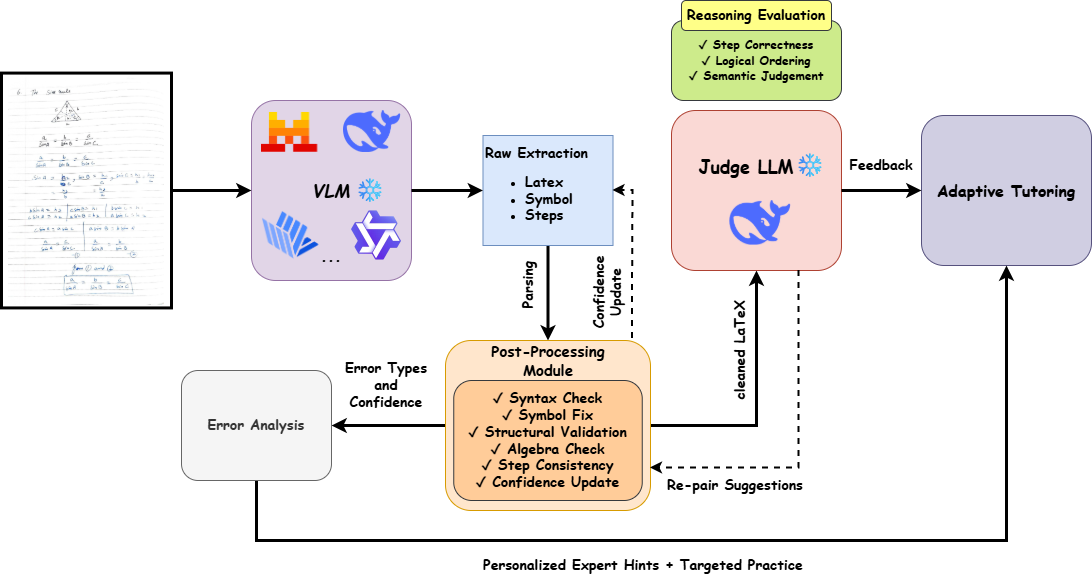
Vision Language Models (VLMs) offer strong surface-level visual understanding. However, current benchmarks do not assess whether these models truly grasp mathematical documents or multi-step derivations. We introduce VLM-Math, a model-agnostic diagnostic framework that breaks down mathematical document understanding into four measurable dimensions: structural comprehension, semantic preservation, reasoning fidelity, and educational viability. The proposed framework uses a five-stage interpretable pipeline: OCR extraction, logical ordering, step-by-step explanation, error detection, and pedagogical feedback.
To bridge transcription and understanding, we propose a six-pass post-processing module. We also add an LLM-as-a-Judge semantic evaluation protocol with explicit hallucination-rate monitoring and an adaptive tutoring component. Order quality is evaluated using both absolute-position accuracy and Kendall's τ rank correlation. Evaluations on VLM-Math-100 with domain-stratified and bootstrap-validated results show a recurring pattern: models achieve high surface fidelity but much weaker performance in semantic consistency and step-level coherence, revealing a significant gap between confidence and actual accuracy.
VLM-Math serves as a scaffold diagnostic benchmark that measures capability ceilings through staged prompting rather than monolithic end-to-end deployment, and provides detailed, stage-wise diagnostics to advance reliable and pedagogically useful mathematical reasoning in multi-modal systems.
Dataset: VLM-Math-100
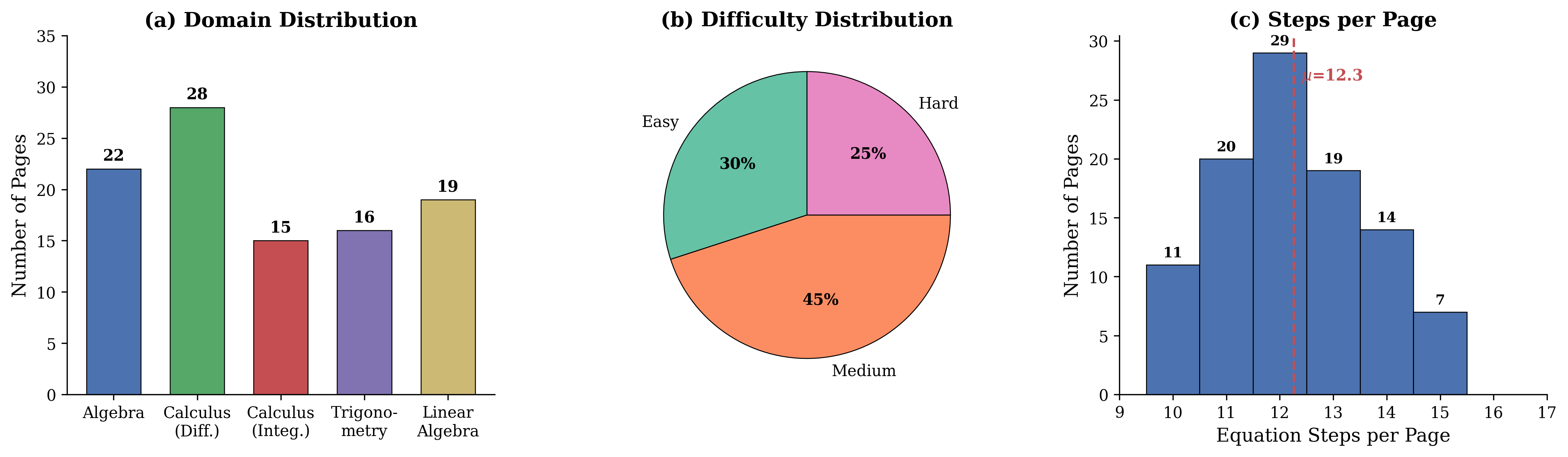
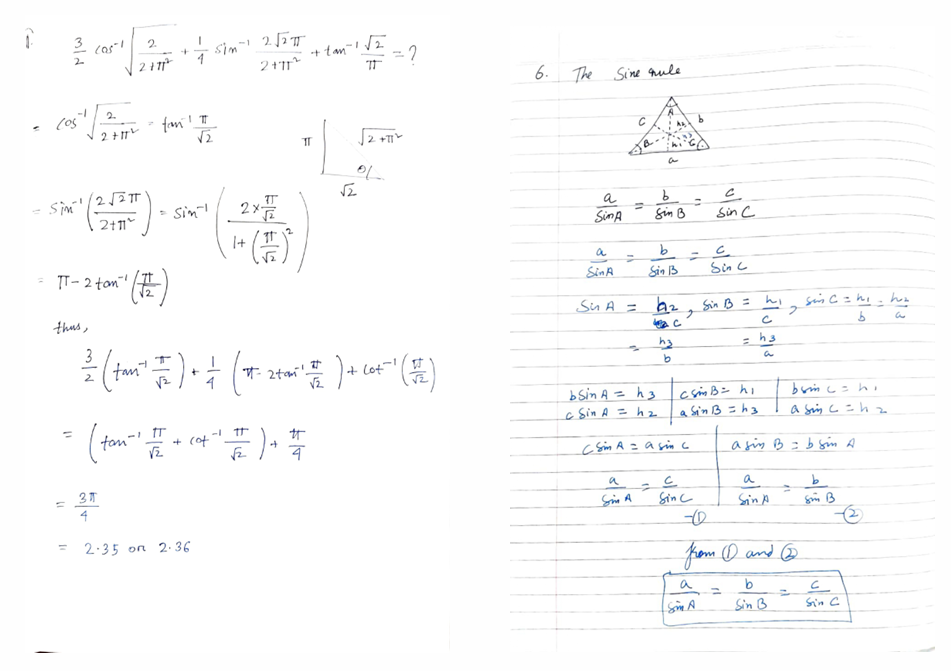
A curated set of 100 handwritten multi-step mathematical pages spanning algebra, calculus, trigonometry, and linear algebra.
Five-Stage Interpretable Pipeline
Rather than treating handwritten mathematical understanding as a monolithic image-to-LaTeX task, VLM-Math decomposes it into five sequential, interpretable stages.
1. OCR Extraction
Converts visible handwritten mathematics into LaTeX, evaluated using BLEU, normalized edit distance, and symbol-level P/R/F1.
2. Logical Ordering
Orders derivation steps as the author intended, handling non-linear layouts such as margin equations and flow arrows.
3. Step Explanation
Produces a natural-language explanation for each derivation step, judged for faithfulness to the underlying operation.
4. Error Detection
Identifies algebraic and logical errors — sign errors, invalid simplifications, unsupported transformations — verified with SymPy.
Quantitative Results
Evaluated on VLM-Math-100 using our five-stage pipeline (OCR → Ordering → Explanation → Error Detection → Feedback).
Comprehensive VLM Comparison
| Model | BLEU-1↑ | BLEU-4↑ | NED↓ | Symbol F1↑ | Order Acc.↑ | Kendall's τ↑ | Step Corr.↑ | Overall↑ |
|---|---|---|---|---|---|---|---|---|
| Phi-3.5-Vision | 0.5923 | 0.4489 | 0.5034 | 0.6689 | 0.0521 | 0.1234 | 0.0417 | 0.4389 |
| LLaVA-v1.6-34B | 0.6434 | 0.5012 | 0.4689 | 0.7012 | 0.0938 | 0.1823 | 0.1563 | 0.4856 |
| InternVL2.5-8B | 0.6945 | 0.5612 | 0.4256 | 0.7223 | 0.1354 | 0.2456 | 0.0729 | 0.4989 |
| Qwen2.5-VL-7B | 0.7178 | 0.5856 | 0.4067 | 0.7345 | 0.1563 | 0.2789 | 0.1354 | 0.5147 |
| Ministral-3-14B | 0.6789 | 0.5442 | 0.4389 | 0.7267 | 0.1042 | 0.2134 | 0.2083 | 0.5248 |
| InternVL3-14B | 0.7698 | 0.6487 | 0.3712 | 0.7563 | 0.2396 | 0.3678 | 0.0208 | 0.5412 |
| Qwen3-VL-8B-Instruct ⋆ | 0.7856 | 0.6641 | 0.3523 | 0.7634 | 0.2813 | 0.4156 | 0.1979 | 0.5617 |
| Gemini-3.0-Flash | 0.8078 | 0.6878 | 0.3123 | 0.7834 | 0.3542 | 0.5134 | 0.2708 | 0.6156 |
| GPT-4.1 | 0.8289 | 0.7023 | 0.2689 | 0.7998 | 0.3958 | 0.5712 | 0.3125 | 0.6345 |
| Gemini-3.0-Pro | 0.8412 | 0.7234 | 0.2945 | 0.8156 | 0.4583 | 0.6234 | 0.3542 | 0.6589 |
Domain-Stratified Symbol F1
| Model | Algebra↑ | Calculus↑ | Trigonometry↑ | Linear Algebra↑ | Δ (max−min)↓ |
|---|---|---|---|---|---|
| Qwen3-VL-8B-Instruct ⋆ | .7823 | .6978 | .7534 | .6823 | .1000 |
| InternVL3-14B | .7612 | .6756 | .7312 | .6534 | .1078 |
| Gemini-3.0-Flash | .8012 | .7534 | .7823 | .7867 | .0478 |
| GPT-4.1 | .8234 | .7745 | .8034 | .7612 | .0622 |
| Gemini-3.0-Pro | .8523 | .8012 | .8289 | .7834 | .0689 (GPT-4.1 lowest overall) |
Dataset Samples
Citation
If you find this work useful, please consider citing our paper.
@InProceedings{10.1007/978-3-032-36039-7_37,
author="Mitra, Shree and Mondal, Ajoy and Jawahar, C. V.",
editor="Fink, Gernot A. and Forn{\'e}s, Alicia and Kise, Koichi and Lopresti, Daniel",
title="Can VLMs Understand Handwritten Mathematical Documents?",
booktitle="Document Analysis and Recognition -- ICDAR 2026",
year="2027",
publisher="Springer Nature Switzerland",
address="Cham",
pages="628--644",
isbn="978-3-032-36039-7"
}